
Why Every Company Wants to Film in the Conference Room (And Why We Secretly Hope They Don’t)
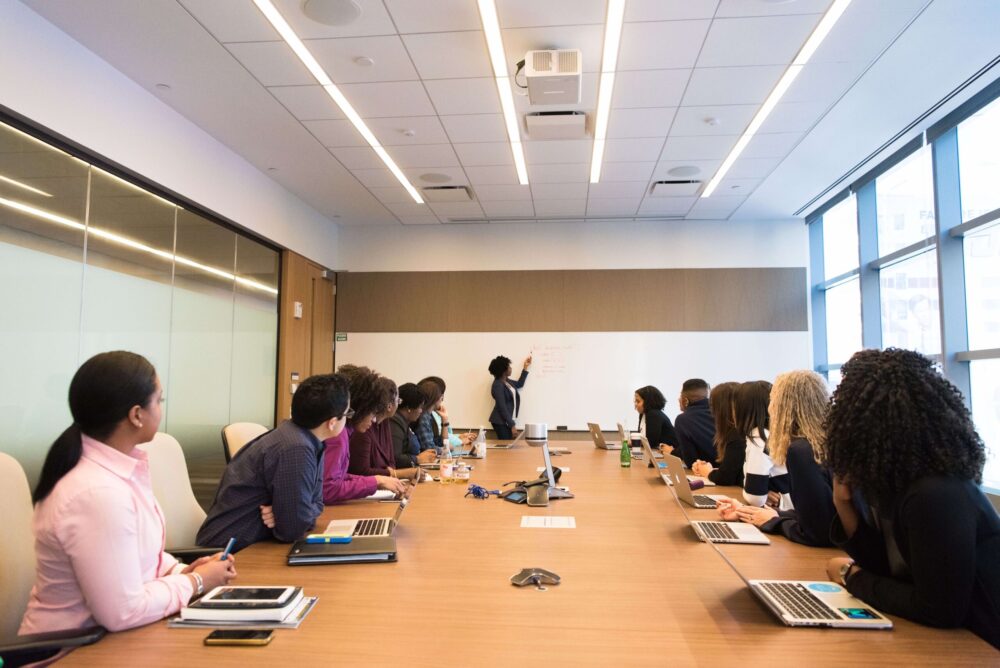
There is a moment on almost every corporate shoot when someone proudly opens the door to a conference room and says:
“We thought this would be a great place to film.”
And we understand why.
Conference rooms are designed to look professional. They have large tables, comfortable chairs, company logos on the walls, impressive views, and usually some very expensive artwork that someone spent a lot of time choosing.
On paper, they seem like the perfect location for an executive interview or corporate video.
Then the film crew walks in.
And immediately starts noticing everything the human eye ignores.
The giant reflective table. The overhead fluorescent lights. The glass walls creating unwanted reflections. The air conditioning unit that has apparently been waiting all morning for the exact moment the CEO starts answering the most important question of the interview. The conference room chair that looks comfortable until someone sits down in it and suddenly looks like they are waiting at the DMV.
The funny thing about conference rooms is that they are usually the first place people suggest — and often the first place a production crew starts making a mental checklist of challenges.
It’s not because conference rooms are bad.
It’s because they were designed for meetings, not filmmaking.
And those are two very different things.
Sometimes the Best Location Is Not the First Location
After walking into a conference room and taking a quick look around, there is a moment every experienced production team has had.
The producer starts thinking through the schedule.
The DP starts studying the light.
The camera operator starts looking for possible angles.
And eventually someone asks the question:
“Is there another space we could take a look at?”
It’s not because the conference room is bad. In fact, it’s usually a perfectly nice room. It’s just that filmmaking has very different requirements than having a successful quarterly meeting.
A space that works beautifully for ten executives sitting around a table does not always work well for a professional interview setup with cameras, lighting, audio equipment, client monitors, and a crew trying to create a cinematic image.
Sometimes the best production decision is not figuring out how to force a room to work — it’s finding a room that naturally gives us what we need.
An empty office, a hallway with interesting depth, a lobby with natural light, or even a workspace where employees actually do their jobs can often create a much stronger visual story than the conference room everyone assumed would be the obvious choice.
And sometimes the answer is somewhere completely unexpected.
A basement, for example, may not sound like the dream location for a corporate interview. But from a filmmaker’s perspective, it can actually be a fantastic space.
Why?
Control.
A basement usually has little or no outside light, which means we can completely control the look. We can bring in our own lighting, build a custom backdrop, decide exactly what is in the frame, and shape the environment to match the story we are trying to tell.
Add some sound blankets to help reduce reflections and control unwanted noise, and suddenly that forgotten basement can become a beautifully controlled interview studio.
The perfect filming location isn’t always the one with the most impressive architecture.
Sometimes it’s the one that gives us the most creative freedom.
The Space Problem Nobody Thinks About
One of the biggest misconceptions about filming interviews is that you only need enough room for a camera and the person sitting in front of it.
The reality is very different.
A professional interview setup requires space. Not just for the subject and the camera, but for everything happening around them.
We need room between the subject and the camera to create the right framing and perspective. We need space behind the subject to create depth and separation. We need room for light stands, flags, diffusion, monitors, audio equipment, and the crew operating everything.
We also need space for clients or producers to comfortably watch the interview without accidentally becoming part of the lighting setup.
A good interview setup is almost like building a small studio inside an existing environment.
And this is where conference rooms can become a challenge.
They often look large when you walk in, but they don’t always have usable production space.
The biggest obstacle is usually sitting right in the middle of the room:
The conference table.
That massive, beautiful, expensive table that everyone loves during meetings suddenly becomes the production team’s biggest enemy.
It is often too heavy to move, too large to work around, and positioned exactly where we need our camera, lighting, or client viewing area to go.
Everyone loves the conference table.
The camera does not.
The table was designed to bring people together. Unfortunately, it was not designed to make room for a cinema camera, three light stands, a producer, a sound mixer, and a client monitor.
Sometimes the best solution is simply accepting that the table is staying and finding a creative way around it.
Other times, we politely ask:
“Is there any chance this table moves?”
The answer is usually no.
And we completely understand why.
Nobody wants to explain to the CEO why the conference table they approved last year is suddenly being rolled into the hallway.
The Problem With “Good Enough” Lighting
Most conference rooms are designed for meetings, not filmmaking.
The lighting is usually created to illuminate a room, not flatter a person’s face. Overhead fluorescent lights can create harsh shadows, unflattering skin tones, and those dreaded circles under someone’s eyes that make even the most well-rested executive look exhausted.
The solution is rarely just turning on more lights.
Good cinematography is about controlling light, not simply adding more of it.
Our crews often reshape the existing environment by turning off overhead lights, bringing in soft sources, adding negative fill, and creating depth so the interview feels intentional rather than like someone happened to set up a camera in a meeting room.
A good DP can make almost any space work, but sometimes the best thing we can do is fight what the room was designed to do.
The Battle Against Reflections
Conference rooms love glass.
Architects love glass.
Film crews… sometimes have a more complicated relationship with glass.
Glass walls, glass tables, and shiny surfaces can create reflections that reveal cameras, lights, crew members, and equipment.
Suddenly the beautifully designed executive conference room becomes a giant mirror.
We’ve all been there: moving a light two inches, changing a camera angle five degrees, or asking someone to move a decorative plant because it is perfectly reflecting a $10,000 camera package back into the shot.
It’s a constant game of hide-and-seek.
Except instead of hiding from a person, we’re hiding from ourselves.
The Sound Problem Nobody Thinks About
The biggest challenge with conference rooms is often not what you see.
It’s what you hear.
Large open spaces with hard surfaces create echoes. Glass walls, conference tables, and exposed ceilings bounce sound around the room, making it difficult to capture clean dialogue.
Then there are the sounds you can’t control.
The HVAC system kicks on.
Someone starts a meeting in the room next door.
An office printer begins its daily battle.
A person walks by talking loudly on a phone.
These are all things that seem insignificant until you are recording an important interview and suddenly need everyone in the building to stop moving for 30 seconds.
The funny thing is, these sounds never happen during the lighting setup.
They only appear once the camera is rolling.
Almost like they know.
So Why Do We Still Film in Conference Rooms?
Because sometimes they are exactly the right choice.
A company’s headquarters tells a story. The location can communicate credibility, culture, and success. An executive sitting in their own environment can feel more authentic than placing them in a generic studio.
The trick is understanding that the room itself is only the starting point.
The job of a production team is not just to show up and press record. It’s to evaluate the space, find the best angles, control the environment, and turn an ordinary location into something visually compelling.
Sometimes that means moving furniture.
Sometimes it means hiding a plant stand behind the camera.
Sometimes it means convincing everyone that the giant conference table everyone loves needs to be pushed six feet out of frame.
And yes, sometimes it means having a very polite conversation with the person who designed a room entirely out of glass.
The Secret Is Preparation
The best-looking corporate videos are rarely created by accident.
They come from preparation, problem-solving, and a crew that knows how to adapt.
A challenging location isn’t necessarily a bad location. It just requires more creativity.
At Grand Street Media, we’ve filmed in boardrooms, offices, factories, warehouses, hotels, basements, and just about every type of corporate environment you can imagine. Every location has its challenges, and every location has potential.
The next time you walk into a conference room and think, “This would be a great place to film,” just remember:
Your production crew is probably looking at the same room and thinking about how to make the impossible look easy.
That’s the magic of filmmaking.